

MRL vs Traditional Elevators: Which One is Right for Your Building?
Selecting the appropriate elevator for your premises is not always the most straightforward process. With new technologies emerging, owners of buildings often struggle to choose between traditional elevators or MRL (Machine Room Less) elevators. If space is tight, energy efficiency is required, and you want a more modern look, then a machine room-less lift is more than likely a good choice. If you require heavy-duty performance in a high-rise building, then a traditional elevator may still be the better option for you.
In this blog we will help distinguish what some of the differences are between these two elevator types, where you ideally will use them, and what real-time use tells us. By the end, you’ll be able to weigh the pros and cons like a pro and figure out what’s best for your specific building.

What Is a Traditional Elevator?
Traditional elevators are the ones we’ve seen for decades. They incorporate a distinct machine room either overhead (in the case of hydraulic elevators) or at basement level, which is separate from the lift shaft and provides space to house a motor, control panel, or other heavy machinery that is integral to the lift operation.
Traditional elevators are typically the preferred solution for high-rise buildings or places that experience a lot of traffic. These elevators can handle more weight, operate at higher speeds, and are generally more durable. One primary benefit is ease of access for technicians. As they are installed in a distinct machine room for routine lift maintenance or elevator repair maintenance, everything is laid out in one spot.
But that convenience comes with a trade-off. Machine rooms take up extra space and can increase construction and operating costs. You are also going to need adequate ventilation and, in some cases, air conditioning in that space, which will increase costs even further.
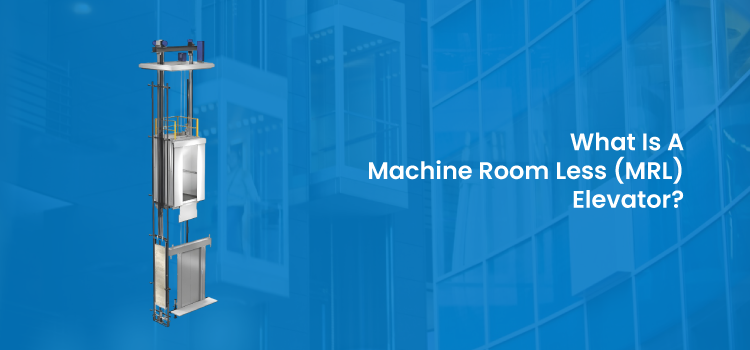
What Is a Machine Room Less (MRL) Elevator?
As the name suggests, a machine room-less elevator does not have a machine room, and the machinery and control systems are compactly designed into the shaft or right above the elevator cab, truncating the amount of space required for installation, making it desirable for many types of building structures of today.
Not surprisingly, due to the built environment in many urban settings, the demand for energy-efficient machine room-less lifts is rising. Builders of high-rise buildings are limited in real estate and want to use every precious inch as possible. Most machine room-less lifts use gearless traction motors, which consume considerably less energy for their operation and produce much less heat than traction lifts with machines. All that sounds good, but they have mechanical and controllability issues too. Sometimes access is difficult since everything is packed together in a smaller area. Thus, elevator companies in Mumbai and cities alike need licensed technicians trained to operate and understand in detail how machine room-less lifts and compact systems operate. Also, in very tall buildings, MRL systems may not perform as well under heavy load or continuous use.
Still, for mid-rise commercial buildings or residential projects, a machine room-less lift checks off a lot of boxes.
Which One Is Right for You?
This really depends on your building’s height, foot traffic, and space availability. Best for the small footprint and construction cost, MRL elevators are clever choices during modest performance, especially in buildings of around 25 floors.
Conversely, if you have a high-rise building that is experiencing heavy use, like a mall, hospital, or corporate tower, then traditional elevators would be much better suited, as they can carry more and faster and usually have a better breakdown track record since they need to be serviced less than MRLs.
We should also contemplate the consumption of energy: Since MRL elevators consume roughly 30% less energy than whole elevator whips, they would win in the category if the building is green or if a developer wishes to save money on utility bills.
Another aspect to consider: access for service. Traditional elevators make lift maintenance and elevator repair maintenance simpler due to the dedicated room. MRL elevators, however, may need more time and skilled professionals for upkeep. If you’re located in a city with a wide pool of trained elevator companies in Mumbai, that might not be a problem.
Real-World Example
Let’s say you’re planning a 12-storey residential tower in a crowded Mumbai suburb. Space is limited, and the rooftop will be used for solar panels. You don’t want to allocate extra floor area for a machine room. In this case, a machine room-less lift is the practical choice.
Okay, now try to visualise a luxury hotel being constructed in South Mumbai, with 25-plus floors and a high guest turnover on a 24/7 basis, that would also need high-capacity lifts. In this example, you would want traditional elevators since they will operate much more smoothly in a continuous-use lifestyle, as well as provide easier access for service off-hours, since the design of traditional elevators is simpler to deal with when damping out the stress of continuous use.
So, context is key. A well-informed decision often means fewer problems down the road, and the type of building plays a big role in that.
Final Recommendation
Both traditional and machine room-less elevators have their strengths. Traditional elevators are tried and tested for high-volume, high-rise applications. They’re sturdy, relatively easier to repair, and work best where space is not a constraint.
On the flip side, machine room-less lifts are the go-to for newer, compact, and energy-conscious buildings. Their space-saving design makes them especially attractive for developers in crowded urban settings. If you’re choosing between the two, ask yourself: how tall is my building, how often will the elevator be used, and how much space can I give up?
Also, consider who’s maintaining it. Some elevator companies in Mumbai specialise in machine roomless lifts, while others are more tuned to traditional models. Make sure your chosen partner is experienced with the system you pick.
FAQs
1. What distinguishes a traditional elevator from a machine-room-less elevator?
A traditional elevator has a machine room dedicated to the elevator motor and controls, whereas a machine-room-less elevator has these in the shaft and/or elevator headroom to reduce space consumption.
2. Is a machine-room-less elevator safe to use in a residential application?
Yes, machine-room-less elevators have been successfully used in residential buildings and are safe to use. Machine-room-less elevators completely conform to the standards for safety and reliability when properly maintained.
3. Which elevator is simpler to maintain?
Traditional elevators can be easier to maintain due to the separate machine room. Machine-room-less elevators can pose more of a challenge since they are often designed more closely to buildings’ vertical space but have improved accessibility with modern designs.
4. Can I fit an MRL elevator into an existing building?
Absolutely, and it usually works best if space is an issue. Machine-room-less systems are compact and often work well for retrofitting into older buildings where there is limited room.
5. How often should elevators be serviced?
Routine lift maintenance should be carried out every month, but the exact frequency depends on usage. More frequent checks may be required in commercial buildings with high foot traffic.


Leave a Reply