
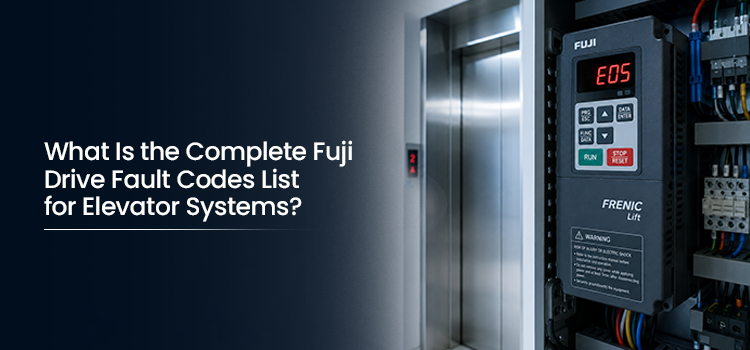
What Is the Complete Fuji Drive Fault Codes List for Elevator Systems?
Elevator systems lean on Variable Voltage Variable Frequency (VVVF) drives to get smooth acceleration, tight speed control, and reliable operation out of the motor. Fuji drives show up a lot in elevators for exactly this reason, they perform well, run efficiently, and come loaded with protection features. Like any smart drive system, they’re constantly watching operating conditions in the background, and the moment something looks off, a fault code shows up on the display.
Getting familiar with Fuji drive fault codes helps technicians spot problems fast, cut down on downtime, and avoid the kind of failures that get expensive quickly. Whether it’s the power supply, the motor, encoder feedback, communication, or overheating causing the trouble, the fault code on screen is really just the starting point of the investigation.
Before diving into troubleshooting any code, it helps to understand how the drive actually controls elevator movement in the first place. Our guide on How Drives Work in an Elevator covers the role VVVF drives, motors, controllers, and braking systems play in keeping the ride smooth and efficient.
What Are Fuji Drive Fault Codes?
Fuji drive fault codes are diagnostic messages the elevator drive throws up the moment it picks up on an operating condition that’s outside normal limits. They exist to protect the drive, the motor, and the elevator system from damage, while also giving maintenance teams a head start on finding the actual source of the problem.
Depending on which drive model you’re dealing with, a fault code might point to an electrical issue, a mechanical one, a communication breakdown, a temperature warning, or something as simple as a parameter that’s set up wrong.
Common Categories of Fuji Drive Fault Codes
Specific codes vary between Fuji drive models, but most of them fall into a handful of general categories.
Power Supply Faults
Power-related faults tend to show up when the incoming voltage is unstable or drifts outside the recommended range.
Common issues include:
- Overvoltage
- Undervoltage
- Input phase loss
- DC bus voltage abnormalities
- Power interruption
These can trace back to unstable electrical supply, damaged wiring, or a faulty power distribution component.
Motor Protection Faults
The drive keeps a constant eye on motor performance so it can step in before excess current or abnormal conditions do any real damage.
Typical motor-related faults include:
- Motor overload
- Overcurrent
- Ground fault
- Motor overheating
- Motor stall detection
Brush off repeated motor faults for too long, and you’re looking at shorter equipment life and repair bills that add up fast.
Encoder Faults
Most modern elevator systems rely on encoders for accurate speed and position feedback.
Common encoder-related problems include:
- Encoder signal loss
- Feedback error
- Pulse detection failure
- Speed feedback interruption
Loose wiring, damaged encoder cables, and faulty encoder units are the usual suspects behind these.
Communication Faults
Elevator drives are constantly talking to controllers, monitoring systems, and other electronic components.
Communication faults can include:
- Serial communication failure
- Controller communication timeout
- Parameter transmission error
- Network interruption
These usually come down to damaged communication cables or a configuration setting that’s off. Communication-related fault codes can also trace back to the elevator control system itself. Our guide on What Is an Elevator Controller? A Beginner’s Guide to the Elevator’s Brain goes into how controllers talk to drives, motors, sensors, and safety devices, worth a read if that’s where the trail leads.
Temperature Protection Faults
Fuji drives come with built-in temperature sensors specifically to protect the internal electronics.
Temperature-related alarms tend to come from:
- Drive overheating
- Cooling fan failure
- High heat sink temperature
- Poor ventilation
Keeping things clean and making sure airflow isn’t blocked goes a long way toward keeping overheating faults off your list.
Most Common Fuji Drive Faults and Their Causes
Some faults show up during maintenance a lot more often than others.
Overvoltage Fault
An overvoltage fault usually pops up when the DC bus voltage climbs past the safe operating limit. Sudden regenerative energy during braking, or just unstable incoming power, can both trigger it.
Worth checking: the power supply, the braking resistors, and the regenerative braking components.
Undervoltage Fault
Drop the input voltage too low and the drive simply can’t do its job properly.
A few usual suspects:
- Weak power supply
- Loose electrical connections
- Power outages
- Faulty circuit breakers
Don’t just restart the elevator and hope. Check the incoming voltage first.
Overcurrent Fault
This one’s straightforward, too much current is running through the motor or the drive.
What tends to cause it:
- Short circuits
- Mechanical overload
- Seized motor bearings
- Incorrect acceleration settings
This isn’t one to sit on. Get it inspected right away, because waiting around risks damage that won’t be cheap to fix.
Encoder Error
Feedback from the encoder is what keeps elevator movement stable. Lose that, and things can get shaky or grind to a stop entirely.
Worth inspecting:
- Encoder cable connections
- Encoder alignment
- Connector damage
- Feedback wiring
Swapping out the damaged encoder component is often all it takes to fix this.
Drive Overheating
Too much heat shortens the life of the electronics and can force an automatic shutdown.
Common reasons include:
- Blocked ventilation
- Dirty cooling fans
- High ambient temperature
- Continuous heavy operation
Routine maintenance is really the best defense here.
How to Troubleshoot Fuji Drive Fault Codes
When a fault code shows up, work through it methodically rather than jumping straight to replacing parts.
Step 1: Record the Fault Code
Prior to handling any components, take notes on everything currently displayed on the screen. The drive can be easily reset, resulting in the loss of the information on the screen.
Step 2: Check the Power Supply
Take a meter and verify the input voltage level. By the way, have a look at the electrical connections to see if anything is loose or damaged.
Step 3: Inspect the Motor
Listen. Unusual noise, signs of overheating, mechanical resistance when it shouldn’t be there, or insulation that’s starting to break down, all worth ruling out here.
Step 4: Verify Encoder Connections
Check that the encoder cables are seated properly and haven’t picked up any physical damage along the way.
Step 5: Review Drive Parameters
Sometimes the fault isn’t hardware at all, it’s a parameter set wrong that’s tripping the protection function. Pull up the manufacturer’s recommended configuration and compare it against what’s currently set.
Step 6: Reset the Drive
Fixed the issue? Reset the drive using the manufacturer’s procedure, then watch how the elevator runs for a bit afterward, don’t just walk away assuming it’s solved.
If the same fault keeps coming back, that’s a sign to dig deeper before putting the elevator back into service.
If the same fault keeps coming back, that’s a sign to dig deeper before putting the elevator back into service.
Preventive Maintenance Tips
A solid preventive maintenance routine cuts down on unexpected downtime and stretches the life of Fuji drives considerably.
Worth building into a routine:
- Clean cooling fans and air filters regularly.
- Inspect electrical terminals for loose connections.
- Check encoder cables during scheduled maintenance.
- Monitor motor insulation resistance.
- Verify brake operation periodically.
- Keep firmware and parameters properly documented.
- Record recurring fault history for trend analysis.
Staying consistent with maintenance is usually what catches a problem while it’s still small, long before it turns into a critical failure.
When Should You Contact a Professional?
Minor stuff, a loose wire here and there, can usually get sorted during routine maintenance. Recurring fault codes are a different story and shouldn’t get brushed aside.
Bring in a professional when:
- The same fault appears repeatedly.
- The drive overheats frequently.
- The elevator stops unexpectedly.
- Communication faults persist after cable inspection.
- Motor or brake faults continue after repairs.
Trying to bypass safety protections isn’t worth the risk it creates, for passengers and maintenance staff alike.
Conclusion
Fuji drive fault codes exist to catch electrical, mechanical, and communication problems before they turn into serious equipment damage. The exact codes vary from one Fuji drive model to the next, but understanding the major fault categories and sticking to a structured troubleshooting process makes diagnosing issues a lot faster and more reliable.
Staying on top of preventive maintenance, keeping parameters properly managed, and inspecting motors, encoders, power supplies, and cooling systems on schedule all add up to fewer surprise breakdowns and a more reliable elevator overall. For fault definitions and fixes specific to your model, always check the official service manual for the Fuji drive actually installed in the system.


Leave a Reply