
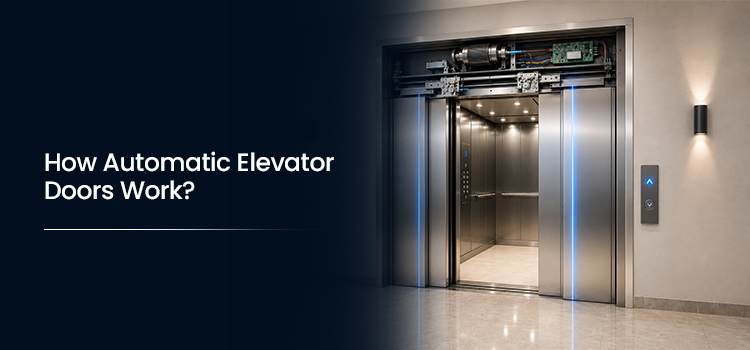
How Automatic Lift Doors Work: A Complete Guide to Elevator Door Systems
Introduction
Step into most modern buildings and you’ll barely notice the automatic lift door doing its job, which is really the point. It’s one of those safety and convenience features that only gets attention when something goes wrong. Residential towers, commercial complexes, hospitals, industrial sites, wherever you find an elevator, automatic elevator doors are quietly making sure people get in and out safely, and that the car itself can’t budge an inch until those doors are shut tight.
Behind that simplicity sits a fair amount of engineering. Sensors, motors, controllers, locking mechanisms, all working in sync to keep things smooth. For building owners, maintenance teams, and facility managers, actually understanding how an automatic door opening system works isn’t just trivia, it’s what helps catch problems early, cut down on downtime, and squeeze more years out of the equipment.
What Is an Automatic Lift Door?
An automatic lift door is a motor-operated door that opens and closes on its own the moment an elevator reaches a designated floor. Unlike manual doors, today’s elevator doors run through an intelligent control system that keeps the elevator car and the landing doors moving in sync.
The whole point of the system is making sure passengers can board and exit safely, while keeping the elevator from moving until every door is completely closed and locked.
Types of Elevator Doors
Not every building needs the same setup. The types of elevator doors that make sense depend on foot traffic, how much space is available, and what the building actually needs day to day.
Center Opening Doors These slide apart from the middle, which speeds up passenger movement considerably. You’ll see them a lot in commercial buildings.
Side Opening Doors Side-opening elevator doors slide in a single direction, and they tend to work well in buildings where space is tight.
Telescopic Doors Multiple panels slide behind each other here, which gets you a wider opening without eating up extra wall space.
Glass Elevator Doors A lot of modern elevators go with sliding glass door automatic systems these days, mixing good looks with solid functionality. That combination makes them a natural fit for hotels, shopping malls, and higher-end residential buildings.
Main Components of an Automatic Lift Door
A handful of parts work together behind the scenes to keep an automatic door opening system running safely and efficiently.
Door Operator The door operator relies on an electric motor to control how the automatic lift door opens and closes.
Door Controller The controller handles door movement, speed, acceleration, and timing, all while staying in constant contact with the elevator control system.
Door Panels These are simply the visible elevator doors, the parts that slide open and shut every time the elevator stops.
Safety Sensors Infrared sensors watch the doorway for passengers or objects, and they’ll stop the automatic door from closing until the entrance is actually clear.
Door Interlocks Door interlocks make sure the elevator physically can’t move until every automatic lift door is fully closed and locked down.
How an Automatic Door Opening System Works
Every time the elevator hits a floor, a modern automatic door opening system runs through the same tight sequence, in the same order, without fail.
Step 1: Elevator Arrives at the Floor First, the elevator controller lines the cabin up precisely with the floor that was selected.
Step 2: Door Unlocking The moment the elevator’s actually level with the landing, the lock releases.
Step 3: Automatic Door Opening Then the door operator kicks in and the automatic lift door glides open along its guide rails.
Step 4: Passenger Detection The whole time this is happening, sensors are watching the doorway. Anything blocking it, a person, a bag, a stray cart, and the automatic door stops closing right away and swings back open.
Step 5: Door Closing Once everyone’s in or out, the automatic door opening system brings the doors back together, controlled and steady.
Step 6: Safety Confirmation Last thing before the cabin’s allowed to move anywhere: the elevator control system checks, properly checks, that every one of the elevator doors is locked.
Safety Features of Automatic Lift Doors
Modern automatic lift door systems come loaded with a range of safety technologies, including:
- Infrared safety sensors
- Door interlock mechanisms
- Obstruction detection
- Automatic reopening function
- Speed-controlled door operation
- Emergency release systems
Together, these features go a long way toward keeping passengers safe while cutting down on operational risk.
Common Problems with Automatic Lift Doors
Even a well-built automatic lift door isn’t maintenance-free. It still needs regular attention to keep performing the way it should.
What tends to go wrong:
- Sensor malfunction
- Door misalignment
- Worn rollers
- Damaged door operator
- Faulty door interlocks
- Controller communication errors
- Obstructions in the door track
None of these are dramatic on their own. But leave them unchecked, and they’re exactly the kind of thing that turns into unplanned elevator downtime down the line, catching them early is really the whole game.
Maintenance Tips for Elevator Doors
Honestly, most of what keeps elevator doors running well isn’t complicated. It’s just consistency.
Recommended practices include:
- Clean door tracks regularly.
- Inspect sensors and wiring.
- Lubricate moving components where recommended.
- Test the automatic door opening system during scheduled servicing.
- Check door alignment.
- Replace worn rollers and guide shoes.
- Verify door controller settings.
Benefits of Automatic Lift Doors
Installing an automatic lift door brings a fair number of advantages along with it.
- Improved passenger safety
- Faster elevator operation
- Better accessibility
- Reduced manual effort
- Smooth and quiet operation
- Lower maintenance costs
- Enhanced building aesthetics
- Reliable long-term performance
A lot of premium buildings end up going with sliding glass door automatic systems specifically because they get elegant design and dependable functionality in one package.
Conclusion
An automatic lift door is a lot more than a nice-to-have convenience feature. It’s a genuinely critical safety component in every modern elevator system. Bring together smart controllers, sensors, motors, and locking mechanisms, and what you get is an automatic door opening system that keeps things running smoothly while protecting passengers on every single trip. Regular inspection and upkeep of elevator doors is really what maximizes reliability, keeps downtime to a minimum, and stretches the service life of the whole elevator system.


Leave a Reply