
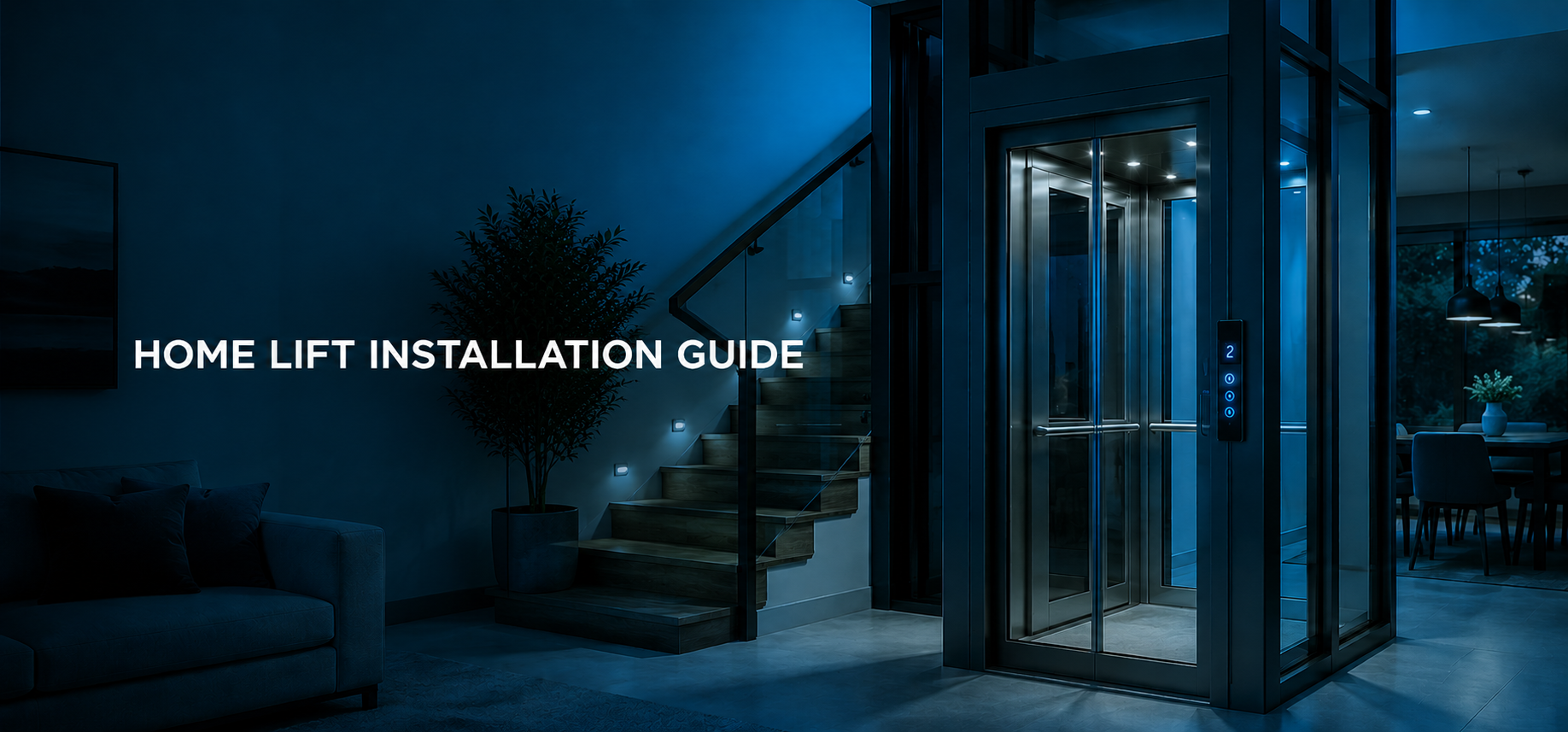
Home Lift Installation Guide: Everything You Need to Know Before You Buy
Why Invest in a Home Lift?
A home lift used to be something you’d only see in very large bungalows or heritage properties. That’s changed. Compact residential lifts are now a real option for mid-sized homes, newly built duplexes, and older properties being renovated for family members with mobility challenges. The decision to install a lift for a residential building comes down to a few things: accessibility needs, long-term property value, and how much convenience actually matters to daily life across multiple floors. For aging parents who manage stairs fine now but may not always, or for families where carrying children and heavy loads between floors is a daily reality, a home lift solves a problem that stairs simply don’t.
Types of Home Lifts Available in India
Different types of residential lifts are available in the Indian market for various requirements, such as different sizes of houses and budgets. Some examples are as follows:
Hydraulic Home Lifts
This type works through a hydraulic piston mechanism and is famous for its quiet operation. Manufacturers of hydraulic lifts in Mumbai and other places in India provide residential hydraulic lifts. The hydraulic lifts need a machine room beneath the shaft. It suits tall residences that have enough space to house the lift.
Pneumatic (Vacuum) Lifts
This type of lift uses vacuum technology to raise and lower the cabin. This type of lift is compact; no pit and machine room is required. The design of the lift is unique; the cabin is mostly transparent.
Traction (Cable-Driven) Lifts
Traction lifts use steel cables and a counterweight system. They’re energy-efficient, handle higher floor counts well, and are the standard type used in most commercial buildings. Home installation of a lift using traction systems is common in larger residential properties.
Stairlift
A stairlift isn’t a full cabin lift but a motorised chair that moves along a rail fitted to the staircase. It’s the least invasive option and suits homes where full home lift installation isn’t feasible structurally or financially.
Platform Lift (Wheelchair Lift)
An open or partially enclosed platform that travels between levels. Primarily for accessibility. Can be installed in a lift for residential building applications where full cabin space isn’t available or necessary.
How to Determine the Right Lift for Your Home
Before you commit to anything, a few practical questions narrow the decision down quickly:
- How many floors does the lift need to serve? More floors generally rule out pneumatic options
- What load capacity is needed? Standard home lifts handle 2 to 4 persons; heavier requirements change the spec
- Does the home have an existing stairwell or open shaft space, or will one need to be created?
- Is a pit feasible under the proposed shaft location? Hydraulic systems typically need one
- What’s the primary use: daily convenience, elderly or mobility-impaired family members, or resale value?
- What budget is available not just for purchase but for the installation of lift infrastructure and ongoing maintenance?
Space and Structural Requirements Before Installation
This is where a lot of first-time buyers get surprised. Home lift installation doesn’t just involve the lift itself. The building needs to accommodate the shaft, the pit (in most hydraulic and traction systems), and, in some cases, a machine room. For hydraulic systems, the pit is typically 150 to 200mm deep, which is manageable in most ground floors. The shaft needs to be plumb and structurally supported, which means the walls around it have to be assessed by a civil engineer or the lift installer before work begins. Older homes sometimes need reinforcement. New construction has an easier time because the shaft can be planned from the start. Either way, getting a structural assessment done before pricing anything is essential.
Essential Safety Features Every Home Lift Should Have
Don’t compromise on safety specifications, regardless of budget. A residential lift is used by family members, often unsupervised. The following are non-negotiable:
- Automatic door locking to prevent the cabin from moving unless all doors are fully closed and secured
- Emergency stop button accessible from inside the cabin at all times
- Backup power or battery operation so the lift can descend to the nearest floor during a power cut
- An overload sensor that prevents operation when the weight exceeds the rated capacity
- Anti-fall device and safety buffers at the base of the shaft
- An intercom or alarm system connecting the cabin to the home’s main floor
- Manual lowering or emergency release system for use by building occupants or technicians
Any reputable hydraulic lift manufacturer in Mumbai will include most of these as standard. If a quote doesn’t specify them, ask directly before signing anything.
Home Lift Installation Process Explained
The actual installation of lift hardware typically runs across several phases. First, the site is assessed, and the shaft space is prepared, whether that means constructing a new shaft or modifying an existing stairwell. Civil work comes first and takes the most time in older properties. The construction process is completed by fitting out the lift structure inside the elevator shaft. In the case of a hydraulic elevator, the hydraulic pump is mounted in the pit and connected to the electricity source. Panels, doors, and controls for the cabin are then installed. The final stage is a series of load tests. A full home lift installation from civil preparation to commissioning typically takes two to four weeks, depending on site complexity. The more prep work done upfront, the smoother the actual installation runs.
Regulations and Compliance Requirements
There are certain criteria to be followed while installing a lift in any residential building in India. These criteria include:
- Adherence to IS 14665 regarding BIS (Bureau of Indian Standards) for lift design and safety systems
- Municipal approval regarding the construction of the shaft
- Clearance for the electrical installations
- Inspection yearly by the approved lift inspector after commissioning of the lift
- Load test certificates both during installation and periodically thereafter
- Adherence to NBC (National Building Code) guidelines for vertical residential transport
Reputable providers handle most of this paperwork as part of the service. If a company doesn’t mention compliance requirements during the sales conversation, that’s a flag worth noting.
How to Choose the Right Home Lift Company
The lift market in India has grown fast, and not every provider has the technical depth or after-sales support to back up a residential installation. A few things to verify before committing. Check whether the company manufactures or assembles its own systems or simply resells imported units. Local manufacturing usually means better availability of spare parts and faster service response. Ask for references from completed residential installations specifically, not just commercial projects.. For your homeowner customers who want a single point of accountability rather than managing multiple vendors, that integrated approach makes the whole project considerably less stressful.
Home Lift Maintenance and Long-Term Care
A residential lift is a mechanical system running in a domestic environment, and like any such system, it needs regular attention to stay safe and reliable. Lubrication of guide rails, inspection of hydraulic fluid levels, testing of safety devices, and software updates for electronic control systems are all part of a standard maintenance schedule. Most quality providers recommend quarterly servicing for a lift for residential building use, with a more comprehensive annual inspection. Keeping a log of any unusual sounds, door behaviour, or levelling issues between service visits helps the technician identify developing problems early. A well-maintained home lift lasts 20 years or more. A neglected one creates safety risks and expensive repair bills well before that. Install it right, maintain it properly, and it’ll outlast most other things in the house.


Leave a Reply